In today’s Hario Mini-Slim Plus review, i will be taking a look at one of the most popular and budget-friendly hand grinder, which fits in a jacket pocket exactly. For under $40, it produces good coffee as long as you are not reaching for the French Press.
In the UK, it's sold as the Hario Mini Mill Plus — same grinder, different name. This review covers the US version. The specs are identical. I bought it to test out for you, and after using it for few months, i will share with you the quality, how the brind settings actually work, which brew methods it suits and whether it’s worth the money.
What's New in the Plus — Upgrades Over the Original Mini-Slim
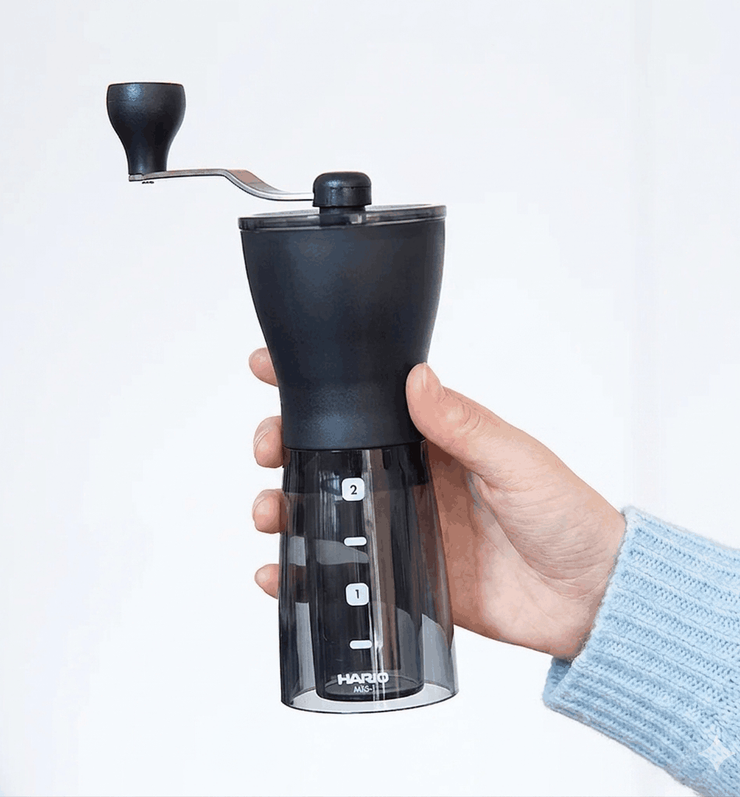
The "Plus" designation covers two targeted improvements. The crank arm has been updated with a reinforced shaft coupling — the original's most-cited complaint was handle wobble during grinding, and this addresses it directly. The handle itself has also been redesigned for better traction, reducing the sensation that the whole assembly is about to come loose mid-grind.
The ceramic burrs and stepped adjustment dial are unchanged from the original. Hario didn't fix what wasn't broken. The upgrades are mechanical and practical, not cosmetic — which is the right call for a grinder at this price.
Build Quality
The plastic-bodied construction is the honest trade-off that makes this grinder viable as a travel tool. It's lighter and slimmer than any Hario glass-bodied model, and it won't shatter on a cobblestone street. The slim cylindrical profile slides cleanly into a backpack bottle holder.
One flag that matters in daily use: there is no anti-slip base. On smooth countertops, the grinder shifts with each crank rotation. Hold the body with your non-dominant hand, or grip it between your knees.
The Ceramic Burrs — Advantage and Honest Limitation
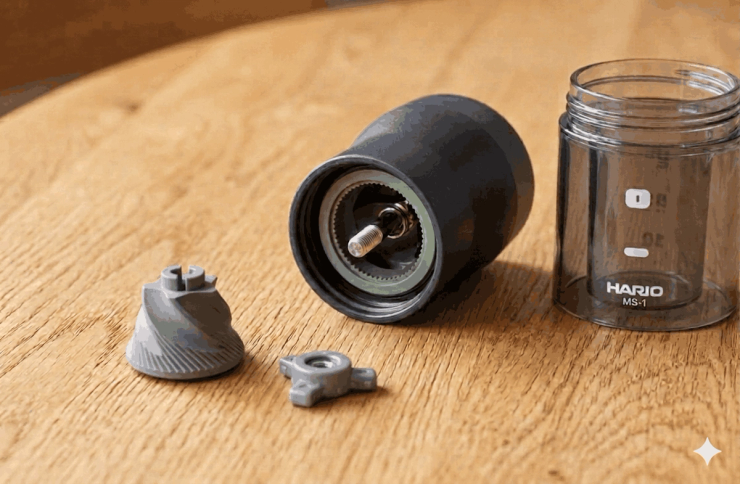
The case for ceramic burrs at this price point comes down to two things. First, ceramic transfers less heat than steel during grinding, and relevant because heat accelerates the off-gassing of volatile aromatic compounds. For a slow hand grind session, the difference is marginal, but it's the right direction. Second, ceramic burrs are washable under warm running water (no soap, no dishwasher), which makes maintenance genuinely low-effort.
The limitation is grind consistency at coarser settings. Ceramic conical burrs produce more fines toward the coarse end of the range than comparable CNC stainless steel burrs. This matters for French press and Chemex, where fines pass through the filter and create a muddier, more bitter cup. It matters less for AeroPress and V60, where the filter catches most of them.
Be careful when handling the removable burr, as ceramic can chip easily.
Grind Settings Guide
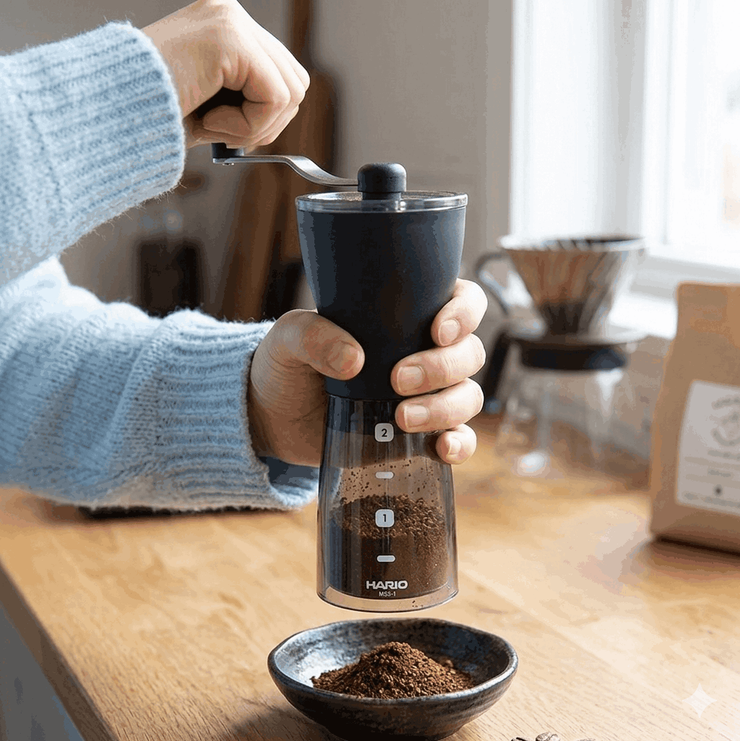
The stepped dial sits beneath the burr assembly. To adjust: unscrew the collection jar, locate the dial, and count clicks from zero — zero being fully tightened. There is no numbered scale on the dial itself. You count clicks, and you remember them.
The grind range runs from 200 to 1,400 microns. The table below gives starting points by brew method. Adjust finer if the cup tastes sour or thin (under-extracted); coarser if it tastes harsh or bitter (over-extracted).
| Brew Method | Starting clicks from zero | Approx. micron range |
|---|---|---|
| Espresso (pressurised basket only) | 4–5 | ~200–300 |
| Moka pot | 5–6 | ~300–400 |
| AeroPress | 6–8 | ~400–600 |
| V60 pour over | ~7 | ~500–700 |
| Chemex | 10–12 | ~700–900 |
| French press | 14–16 | ~900–1,200 |
Note: These are my personal starting points, not fixed targets. Every coffee, every roast level, and every grinder produces slightly different results at the same click count.
Grind Performance by Brew Method
| Brew Method | Performance | Grind Consistency | Cup Result | Verdict |
|---|---|---|---|---|
| AeroPress | Excellent | Consistent at medium-fine | Clean, clear, balanced | Recommended |
| V60 | Very Good | Good fines control | Bright acidity, clean finish | Recommended |
| Moka Pot | Very Good | Comfortable grind range | Rich, stable extraction | Good Match |
| Chemex | Average | Slight inconsistency at coarse settings | Reduced clarity | Acceptable |
| French Press | Poor | Noticeable fines | Muddy / gritty mouthfeel | Not Recommended |
| Espresso (Pressurised) | Limited | Fine enough only for pressurised baskets | Usable but inconsistent | Emergency Only |
| Espresso (Non-pressurised) | Not Suitable | Insufficient precision | Weak extraction control | Avoid |
Portability and Everyday Use
The detachable crank stores flush against the slim body, and the whole grinder weighs next to nothing — almost alarmingly so. It fits in a jacket pocket, sits upright in a backpack water bottle sleeve, and clears carry-on scrutiny without comment.
The 24g capacity is honest about what this grinder is for: one to two cups per session. Pack it for a two-week trip and grind 15g for your AeroPress each morning — that's the use case it was built for. Don't expect to grind for a table of four.
The collection jar has approximate cup-measure markings printed on the side. They are approximate. Use a scale for anything that matters. This is a minor irritant, not a dealbreaker — but it's worth knowing before you rely on the jar markings for your first brew.
Cleaning and Maintenance
- Disassemble — unscrew the collection jar and remove the burr assembly. No tools required.
- Rinse the ceramic burrs under warm running water. No soap. No dishwasher.
- Wipe the body with a damp cloth.
- Frequency — every one to two weeks for daily users; after every few sessions if you switch between coffees with different oil levels.
- Handle the burrs carefully — ceramic can chip if dropped onto a hard surface. This is the one component that can't be easily replaced without a new grinder.
How It Compares — Mini-Slim Plus vs Mini-Slim Pro
The Mini-Slim Pro is the natural upgrade within the Hario range.
| Feature | Mini-Slim Plus (~$40) | Mini-Slim Pro (~$52) |
|---|---|---|
| Body | Plastic (methacrylate resin) | Stainless steel outer |
| Handle | Stainless steel / polypropylene | Aluminium diecast |
| Capacity | 24g | 24g |
| Burrs | Ceramic conical | Ceramic conical |
| Best for | Travel, backpacking, entry-level | Daily home use, durability |
The money difference buys a meaningfully more durable construction: stainless steel outer body instead of plastic, aluminium handle instead of polypropylene. Both of them are ceramic conical, so it doesn’t matter. If this is your everyday home grinder, the Pro is your choice. If it's going in a bag, the Plus's lighter plastic body is actually an advantage.
Who Should Buy the Hario Mini-Slim Plus — and Who Should Upgrade
Buy the Mini-Slim Plus (~$40) if:
- •You want your first proper burr grinder and you're on a budget
- •You're a traveller, camper, or hotel-room brewer
- •Your primary method is pour over, AeroPress, or Moka pot
- •You're upgrading from a blade grinder and want to understand the difference without overspending
Upgrade to the Mini-Slim Pro (~$52) if:
- •You want the same brew method coverage but plan to use it at home daily and want a more durable build
Verdict
The Mini-Slim Plus is something i would definitely keep one as i travel quite a lot. The ceramic burrs handle fine-to-medium settings reliably, the form factor is genuinely slim, and nothing at this price comes close for portability. The coarse grind limitations are real, the 24g capacity is a constraint, and the lack of an anti-slip base is the kind of thing you only notice when you're grinding at speed and the whole thing has migrated across the kitchen counter. None of that changes the core verdict: at under $40, this is the grinder that proves you don't need to spend much to start grinding fresh as long as you're brewing filter coffee, not French press.