In 2023, there was a bit of controversy around the Gaggia Classic Pro EVO because some users reported the boiler coating flaking off and ending up in the water. By 2024, they fixed it with brass. The Gaggia Classic E24 is the company's answer to everything that went wrong with its predecessor: a redesigned machine built around a solid lead-free brass boiler that eliminates the temperature instability and more critically the safety concerns of the earlier aluminum model.
I bought one in 2025 and have been using it daily since, so i can share with you some honest thoughts on how it performs. This review covers what actually changed with the E24, what it's like to use day-to-day, and crucially what you need to budget beyond the $549 sticker price.
If you're considering your first serious espresso machine and you're willing to learn, this guide will tell you whether the Gaggia Classic E24 earns its place on your counter and exactly what it'll cost you to get properly set up.
Quick Verdict — Gaggia Classic E24
Score: 4.2 / 5 | The best entry-level prosumer espresso machine if you're ready to learn.
Best for:
Not for:
What Is the Gaggia Classic E24?
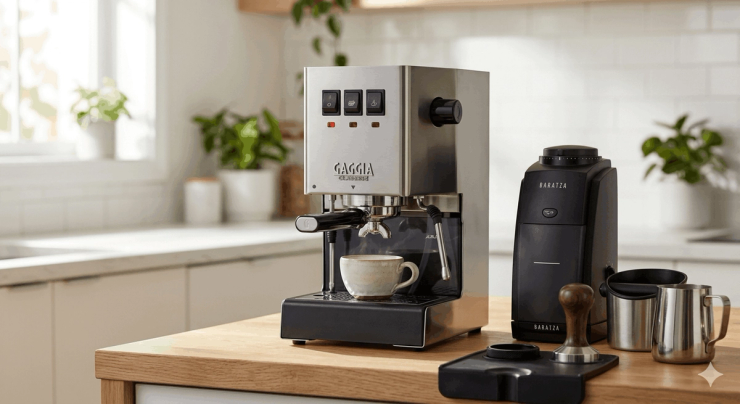
In the US, Gaggia's official site (gaggia-na.com) lists this machine as the Gaggia Classic Pro E24. Internationally, reviewers including Tom's Guide and TechRadar refer to it as the Gaggia Classic E24 Evo Pro. Both names refer to the exact same 2024 machine with the brass boiler.
For clarity, this review uses Gaggia Classic E24 throughout. What matters is that you're buying the 2024 model with the brass boiler not the 2023 Evo Pro with the aluminum one. If you're ordering from Amazon, confirm the listing shows the E24 designation or use the link below before purchasing.
The Brass Boiler Upgrade — What Changed and Why It Matters
The shift from aluminum to lead-free solid brass isn't just a materials upgrade. It's Gaggia fixing a problem that damaged their reputation. In 2023, production units of the Classic Evo Pro (weeks 19–44) shipped with a non-stick coating on the aluminum boiler that began flaking into espresso. This became known as boilergate. Gaggia replaced affected units, but the damage to trust was real. The Gaggia Classic E24 brass boiler is the permanent fix. There's no coating to fail.
Beyond the safety resolution, the brass boiler delivers measurable performance gains. Independent in-puck temperature testing by Whole Latte Love recorded an extraction variance of just 3°F across a shot compared to 7°F on the aluminum boiler. That difference matters: tighter temperature consistency means more reproducible extractions, shot after shot. For reference on what the boilergate issue actually involved in full detail, the Coffeedant boilergate explainer covers it comprehensively.
The brass boiler also runs approximately 25% larger than its predecessor — around 109ml operating capacity versus 87ml on the aluminum version. More thermal mass means more temperature stability throughout extraction, and that benefit compounds with the improved variance figure.
Versions at a Glance
| Model | Year | Boiler | US Price |
|---|---|---|---|
| Classic Pro | 2019 | Stainless steel | ~$449 |
| Classic Evo Pro | 2023 | Aluminum (boilergate risk, wks 19–44) | ~$499 |
| Classic E24 ★ | 2024 | Lead-free brass | $499–$549 |
*If buying new, the E24 is the only version worth considering.
Specs and Build Quality
| Spec | Value |
|---|---|
| Body | 17-gauge one-piece stainless steel — made in Italy |
| Boiler | Lead-free solid brass, ~109ml operating capacity |
| Brew pressure | 9-bar OPV — factory calibrated for US market |
| Group head | Solid brass with stainless steel surround |
| Portafilter | 58mm stainless steel (commercial-style) |
| Solenoid valve | 3-way — produces dry pucks after extraction |
| Steam wand | Commercial-style, 2-hole tip, fixed arm |
| Water tank | 2.1L / 2.2qt removable |
| Heat-up time | Brew-ready light: 71–90 sec. Full stabilisation: 10–15 min recommended |
| Extraction temp | 199.6°F → peaks 202°F → settles ~200°F (3°F variance) |
| Shot control | Fully manual start/stop. No shot timer. No preset dosing. |
| Warranty | 2 years US — confirm current terms on gaggia-na.com |
| In the box | 3 filter baskets, plastic tamp. No milk jug, no backflush disc, no cleaning kit. |
The 17-gauge stainless steel body is built in Gaggia's own Italian factory and not outsourced. The 58mm commercial portafilter and 3-way solenoid valve are features you'd normally pay significantly more for: the solenoid releases pressure after extraction, meaning dry pucks that knock out cleanly and a drier counter.
The made in Italy provenance isn't marketing copy: it's the main reason why i purchased one because this machine is still serviceable and moddable 10+ years after purchase, unlike the majority of machines at this price point. Parts are available, the community is active, and the engineering logic is transparent.
One honest caveat: the machine is relatively lightweight, and you notice it most when locking in the portafilter. The twist-lock requires a firm motion, and in my experience, you end up holding the machine steady with your other hand. It's a small but daily friction point — it runs counter to the premium chassis feel. Once it's part of your routine you stop noticing, but anyone expecting the heft of a heavier prosumer machine should know this upfront.
Espresso Performance
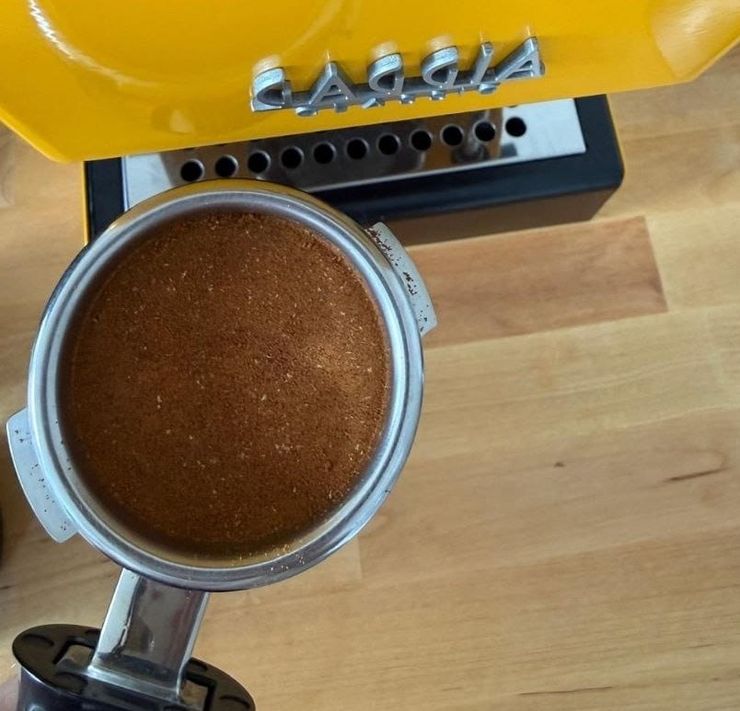
In-puck testing by Whole Latte Love clocked extraction between 199.6°F and 202°F — a variance of just 3°F, rivalling dual-boiler machines at three times the price. The 9-bar OPV on US-market E24 units ships factory-calibrated — unlike older Classic Pro models that required an OPV spring replacement to get down from 12–15 bar. That's a meaningful change for new buyers.
Shot consistency on the E24 is genuinely good once you've found your technique. The temperature surfing window , that brief period after brew light activates where temperature is optimal , runs 1–2 minutes on the E24, compared to up to an hour on older single-boiler machines like the Rancilio Silvia. One important workflow note: always brew before steaming. Surfing back from steam temperature produces under-extracted shots until the boiler cools to brew temperature, and the crema suffers noticeably.
The machine has no built-in shot timer and no preset dosing function — extraction time is controlled entirely manually. Unlike many DeLonghi machines where preset buttons or semi-automatic volume control stop the shot automatically, with the Gaggia you start and stop it yourself. In my experience, once I'd found my routine, it takes roughly 1–2 minutes from switching on to pulling a shot I'm happy with. That's workable — but it is a real learning curve for anyone coming from a machine that does this automatically. For manual shot timing, a phone or dedicated timer solves it immediately.
Steam Wand and Milk Drinks
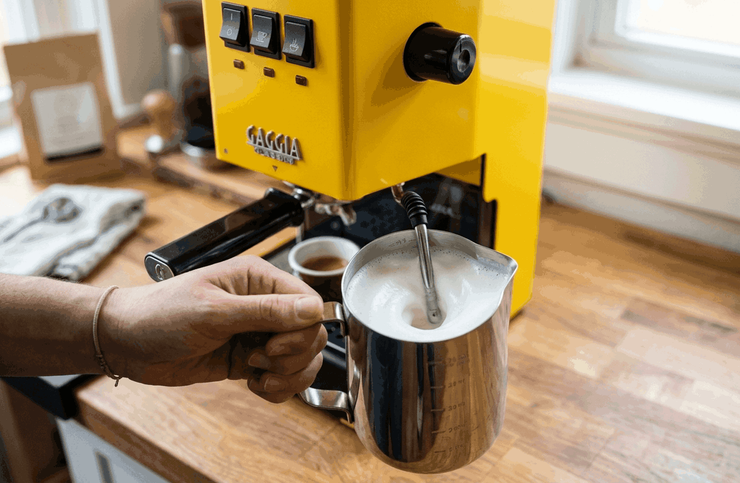
The commercial-style 2-hole steam tip is capable of proper microfoam and latte art: Whole Latte Love's testing clocked 5oz of milk from 42°F to 140°F in approximately 24 seconds. That's meaningful power for this price category.
However, i found that the steam wand's range of motion is limited. Sometimes i end up adjusting my milk pitcher to meet the wand's fixed angle rather than positioning the wand freely. Once i know where the wand sits, it becomes second nature, but it's a genuine limitation compared to machines with a fully articulated wand. An aftermarket articulated tip resolves this for around $15 and is worth flagging as a first upgrade. See the modifications section for more on this.
Compared to a DeLonghi with a panarello wand, I feel that the Gaggia's 2-hole tip is slower and demands more technique. A panarello floods milk with air quickly and produces foam almost automatically. The Gaggia's commercial wand is slower in terms of raw frothing speed — but the trade-off is quality. The 2-hole tip produces proper microfoam that's tighter and more velvety than what a panarello delivers, but you have to earn it.
Design, Colorways, and What's in the Box
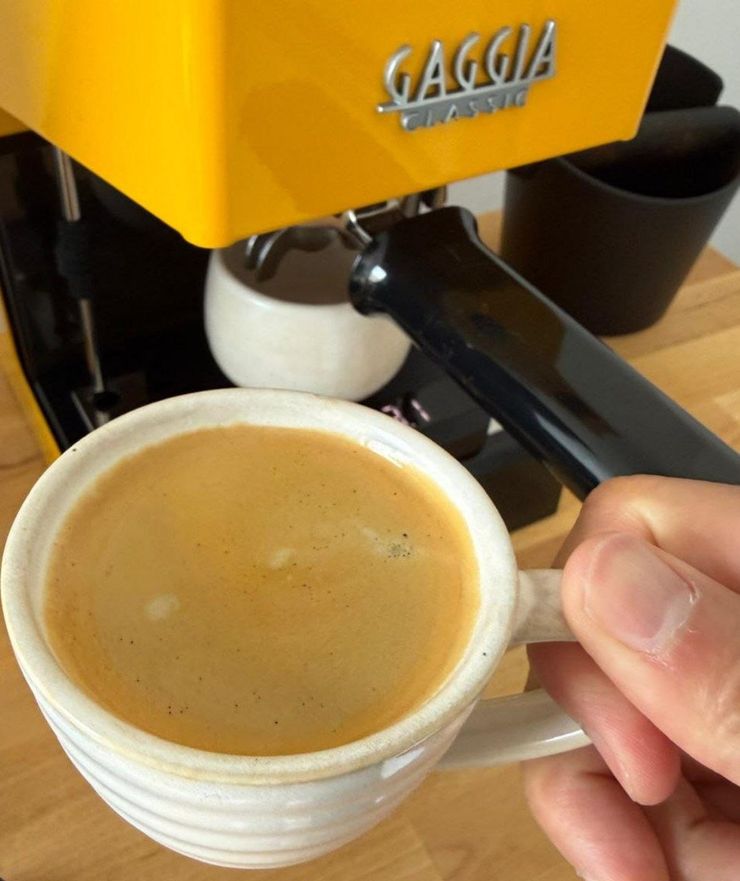
The Gaggia Classic E24 is available in five colorways: Polar White, Cherry Red (Lobster Red), Sunshine Yellow (Canary Yellow), Thunder Black, and Brushed Stainless. Yeah, i got the yellow one. The stainless chassis reads premium in any of them — this is a machine you don't hide in a cupboard. The 2.1L removable tank is among the largest at this price point.
What is notably absent from the box for a $549 machine deserves plain language:
- •Milk jug — not included
- •Backflush disc — not included
- •Cleaning kit — not included
- •Precision tamper — the plastic tamp bundled is essentially unusable for serious espresso work
Budget for these items separately. The accessories section below shows what that realistically adds to your total outlay.
What to Budget Beyond the Machine
$549 is what you pay to own the machine. It's not what you pay to make espresso well. This is the section no competitor currently provides — and it's the most useful thing you can read before buying.
| Item | Approx. Cost (US) |
|---|---|
| Gaggia Classic Pro E24 | $499–$549 |
| Quality tamper (58mm) — affiliate link | $20–$40 |
| IMS precision basket — affiliate link | $30–$50 |
| Milk jug — affiliate link | ~$12 |
| Backflush disc — affiliate link | ~$8 |
| Cleaning tablets — affiliate link | ~$12 |
| Burr grinder — minimum: Baratza Encore — affiliate link | ~$179 |
| REALISTIC TOTAL | ~$760–$860 |
The grinder line deserves emphasis. Without a quality burr grinder, the Gaggia cannot produce consistent espresso — grind consistency is the single biggest variable in extraction quality. The plastic tamp is equally non-negotiable to replace; it's included to satisfy minimum requirements, not to use seriously.
Anyone budgeting exactly $549 is under-budgeted. The realistic total to get properly set up sits between $760 and $860, before coffee beans.
Grinder Pairing
Without a quality burr grinder, the $549 machine is largely wasted. Grind particle consistency is what separates espresso from flavoured hot water — and the grinder choice matters more than almost any other variable. See the best espresso grinders guide for full recommendations.
Entry — Baratza Encore (~$179): The minimum viable starting point. Best if you also brew filter coffee, but requires patience to dial in espresso.
Mid — Baratza Encore ESP (~$229): Specifically redesigned for espresso fineness. Most E24 owners should start here.
Step-up — DF54 or similar single-dose (~$350–$400): For buyers who want to extract everything the E24 can offer and are serious about espresso. Noticeable improvement in shot-to-shot consistency. For a full comparison, see the manual vs electric coffee grinder guide.
Modifications and Upgrades
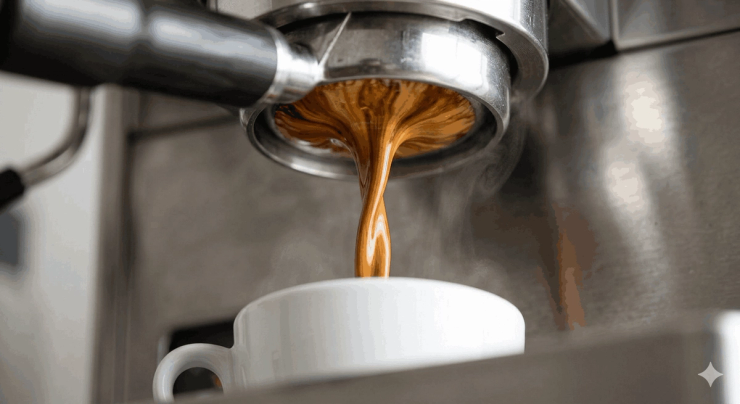
The Classic E24's mod ecosystem is one of its most underrated selling points. These are optional upgrades for experienced one but not requirements. They're worth knowing about when you're evaluating long-term value.
- •PID controller (~$50–$100 DIY): Eliminates temperature surfing entirely by maintaining precise brew temperature electronically. Transforms consistency, especially for lighter roasts. Probably the single highest-impact upgrade available.
- •OPV note: US E24 units ship factory-calibrated at 9-bar — no action required, unlike older Classic Pro models that required a spring replacement.
- •Articulated steam tip (~$15): Fixes the wand's limited range of motion. Highly recommended as a first upgrade based on daily-use experience — see steam wand section above.
- •Dimmer mod: Reduces pump voltage for lower brewing pressure, giving more control over flow rate.
- •Gagguino: An open-source project that adds PID, pressure profiling, and flow control to the Classic platform. The most comprehensive upgrade available, requiring some DIY capability.
Cleaning and Maintenance
The 3-way solenoid valve means dry pucks — a real convenience advantage over machines that produce wet slop in the portafilter. The cleaning routine is straightforward:
- Daily — knock out the dry puck, rinse the portafilter and basket under hot water.
- Weekly — backflush with a blank disc. No cleaning agent needed at this stage.
- Monthly — backflush with a cleaning tablet (such as Cafiza). Flush thoroughly.
- Every 2–3 months — descale, following Gaggia's instructions. Use filtered water as a minimum (Brita or equivalent) to extend descaling intervals and protect the brass boiler long-term.
Filtered water is a genuine recommendation here, not boilerplate. Hard water scale is the main cause of premature boiler failure in machines at this price.
Gaggia Classic E24 vs Breville Bambino Plus
| Feature | Gaggia Classic E24 | Breville Bambino Plus |
|---|---|---|
| Price | ~$499–$549 | ~$499 |
| Boiler type | Lead-free brass single boiler | Thermoblock |
| Heat-up time | ~1–2 min indicator ready;~8–10 min for thermal stability | ~3 seconds |
| Steam power | Commercial 2-hole tip — strong, technique required | Auto-purge, gentler steam — more beginner-friendly |
| Out-of-box accessories | 3 baskets, plastic tamp only | Milk jug, cleaning kit, auto-purge included |
| Build quality | 17-gauge stainless, Italian-made, serviceable | Well-built but less serviceable long-term |
| Longevity | 15–20 years with maintenance | 5–10 years typical |
| Modability | Extensive — PID, OPV, Gagguino ecosystem | Minimal |
| Best for | Enthusiasts willing to learn craft and upgrade | Beginners wanting speed and convenience |
The Bambino Plus is the right machine for complete beginners who want to pull shots immediately, don't want a learning curve, and expect everything included in the box. It's also the correct recommendation for anyone who won't invest in a dedicated burr grinder.
The Gaggia Classic E24 is the right machine for enthusiasts who want craft, longevity, and upgrade potential — and who understand that the $549 sticker is the starting point, not the finish line.
Who Should Buy It — and Who Should Skip It
Buy it if:
- •You're an espresso learner willing to develop genuine skill over weeks, not days
- •You plan to modify — PID, new baskets, articulated tip, eventually Gagguino
- •You want a machine that's still on your counter in 15–20 years
- •You already own or are budgeting for a quality burr grinder
Skip it if:
- •You're a complete beginner who wants out-of-box simplicity — consider the Breville Bambino Plus instead (see the best espresso machines guide for alternatives)
- •You don't have a grinder budget — without a burr grinder, this machine can't perform
- •You're expecting DeLonghi-style automated shot control and preset dosing
- •You need everything included for $549 — it doesn't come close
Verdict
Score: 4.2 / 5. To me, the Gaggia Classic E24 stands out as the best entry-level prosumer espresso machine you can buy if you're willing to meet it halfway. The move to a brass boiler feels like a proper fix to the old boilergate concerns, and it gives me a lot more confidence in long-term reliability.
What I really appreciate is that it still holds onto the fundamentals that make the Classic platform so popular: the 58mm commercial portafilter, Italian manufacturing, and a decade-long mod ecosystem that makes this machine feel like it can grow with you rather than be replaced.
However, I can’t ignore the trade-offs. Without a PID, I still find myself temperature surfing more than I’d like. The included plastic tamper is, in my experience, basically unusable, so you’ll end up replacing it immediately. Since the machine itself is fairly priced, getting it properly set up does mean budgeting extra for accessories. There’s also a real learning curve, especially around timing and consistency if you’re new to manual espresso.
None of these are dealbreakers for me, but they’re things I think buyers should go in with open eyes.
Overall, I don’t think anything else at this price really matches what the E24 offers in terms of build quality, steam power, upgrade potential, and long-term ownership value. The Bambino Plus is still hard to beat for convenience, but for me, the E24 wins where it actually counts if you’re serious about learning espresso over time.
If you're ready to learn espresso properly and invest in a grinder, I suggest you should go for the Gaggia Classic E24 in 2026.