You've decided to stop buying pre-ground coffee. Smart move. Now comes the harder question: do you go with a manual vs electric coffee grinder? The answer isn't complicated but it does depend on how you drink coffee, how much you want to spend, and whether elbow grease in the morning sounds therapeutic or just annoying.
Both types use burr grinders — the only kind worth buying — and both can produce excellent coffee. What differs is price-per-performance, convenience, noise, and portability. This guide breaks down all of it, gives you real data, and ends with a clear verdict for your specific situation.
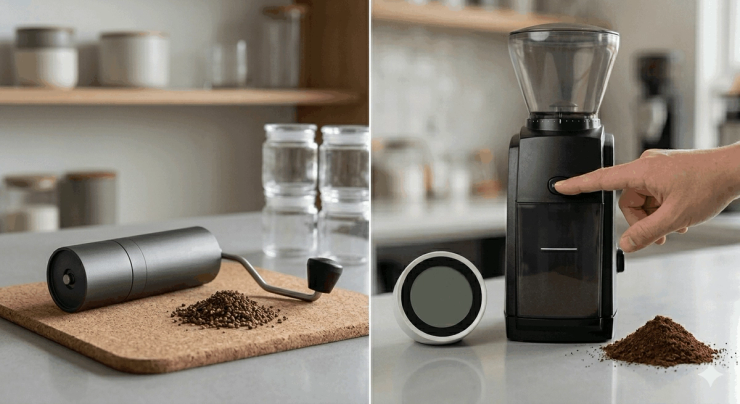
First, Skip the Blade Grinder Entirely
Before comparing manual vs electric, I must tell you this: blade grinders — the cheap spinning-blade kind — should not be considered in this article. They chop coffee randomly into inconsistent chunks. Bigger pieces under-extract (sour, thin); smaller pieces over-extract (bitter, harsh). The last time i used, I ended up drinking both problems in the same cup.
Every grinder in this article is a burr coffee grinder. Burrs crush coffee between two abrasive surfaces set at a precise distance apart, producing a uniform grind size that extracts evenly. [Link: burr grinder vs blade grinder] If you're currently using a blade grinder, that's the first thing to fix — not your recipe.
Manual Coffee Grinders: What You Get
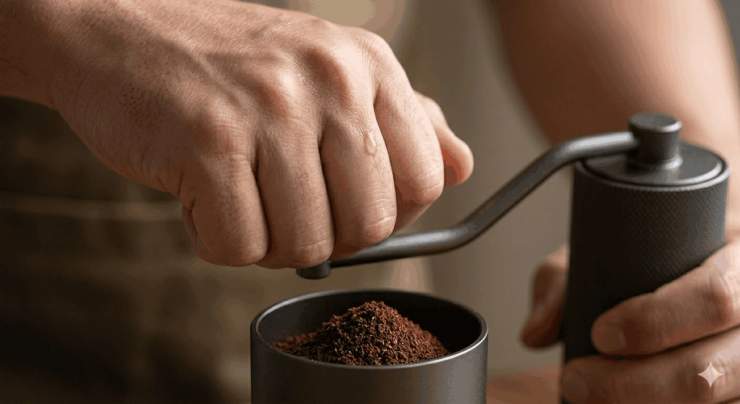
A manual coffee grinder, also called a hand grinder, works by turning a hand crank that rotates a set of conical burrs inside a cylindrical body. You hold it, you turn it, gravity feeds the beans down. No power outlet, no motor, no noise beyond the gentle crunch of beans.
I used a hand grinder for my first two years of specialty coffee, mostly because the Timemore C2 (~$69) genuinely outgrinds any electric I'd tried at that price. It felt meditative on a slow morning — less so when I was half-asleep and late for work. That gap between 'therapeutic' and 'annoying' is where the manual grinder lives, and your honest answer tells you a lot about which direction to go.
| Pros of a manual / hand grinder | Cons |
|---|---|
| Price-to-performance: the burr quality you get for $50–$70 in a manual grinder would cost $150+ to replicate in electric | Physical effort: grinding 15–20g for a pour over takes roughly 60–90 seconds of continuous cranking. Espresso doses (18–20g of fine grounds) can take 2 minutes or more |
| Silent: no motor noise. A hand grinder is barely audible — better for early mornings, shared living spaces, hotels | Slow: grinding 36g takes about 2 minutes by hand vs 35–45 seconds on a Baratza Encore |
| Portable: most hand grinders fit in a side pocket of a backpack. Perfect for travel, camping, or office brewing | Limited capacity: most hand grinders max out at 20–40g — fine for one or two cups, awkward for batches |
| Durable: fewer moving parts, no motor to burn out. A quality hand grinder can outlast most mid-range electrics | Grind adjustment: budget models often use unmarked click-step adjustment with no numbers or reference points, which makes dialing in espresso harder |
| No electricity needed: works anywhere |
Electric Coffee Grinders: What You Get
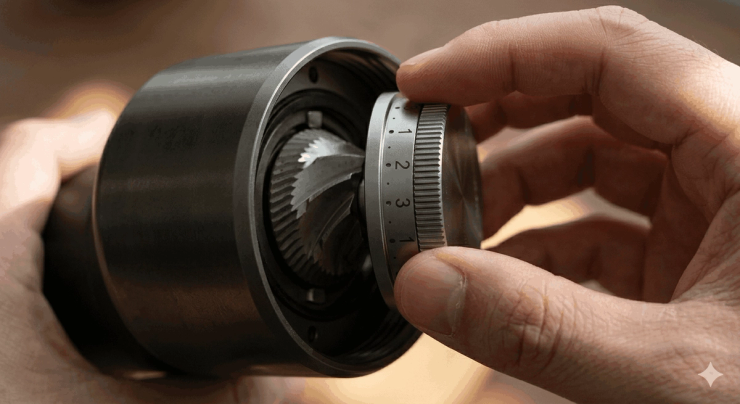
An electric burr coffee grinder uses a DC motor to spin the burrs at a controlled RPM, with a hopper on top feeding beans down through adjustable burrs into a grounds bin below. You set the grind size, press a button, and it's done in under a minute. That convenience is real, and for a busy household it matters.
The critical caveat: don't spend less than $120 on an electric grinder. Sub-$120 electric grinders almost universally use poor-quality burrs that produce inconsistent grinds — worse than a $70 hand grinder. The Baratza Encore (~$179) is widely recognised as the electric quality floor, using 40mm hardened alloy steel conical burrs at a low 450 RPM — slow enough to minimise heat buildup that can dull flavour.
| Pros of an electric grinder | Cons |
|---|---|
| Speed: grinds 36g in 35–60 seconds. Significantly faster for households making multiple cups | Noise: even the quietest electric grinders are significantly louder than a hand grinder. Not ideal for early mornings in shared homes |
| Convenience: press a button. No physical effort. Consistent results with repeatable labeled grind settings | High price floor for quality: you need to spend at least $120–$150 to beat a $70 hand grinder on grind consistency |
| Larger capacity: hoppers typically hold 200–250g, practical for batch brewing | Counter space: most decent electric grinders are large. The Encore weighs 7 lbs and stands 14 inches tall |
| Flat burr option: mid-range and premium electrics (e.g. Fellow Ode) offer flat burrs, which some brewers prefer for espresso uniformity | Static: a common complaint with the Encore is static buildup in the grounds bin, scattering fine grounds |
| Better for espresso at scale: high-end electrics offer micro-adjustment that makes espresso dialing-in more precise and repeatable |
The Key Differences at a Glance
| Feature | Manual / Hand Grinder | Electric Grinder |
|---|---|---|
| Price floor for quality | $50–$70 | $150–$180 |
| Grind speed (36g dose) | ~3 minutes | 35–60 seconds |
| Noise level | Silent | Loud |
| Portability | Excellent — pocket-sized | Poor — large, heavy |
| Capacity | 20–40g typical | 150–250g hopper |
| Espresso capable? | Yes (premium models $100+) | Yes (at $180+, or Encore ESP) |
| Durability | Very high (no motor) | Moderate (motor lifespan varies) |
| Best for | Budget, travel, single cup | Households, convenience, espresso |
Grind Quality: Does Manual or Electric Produce Better Coffee?
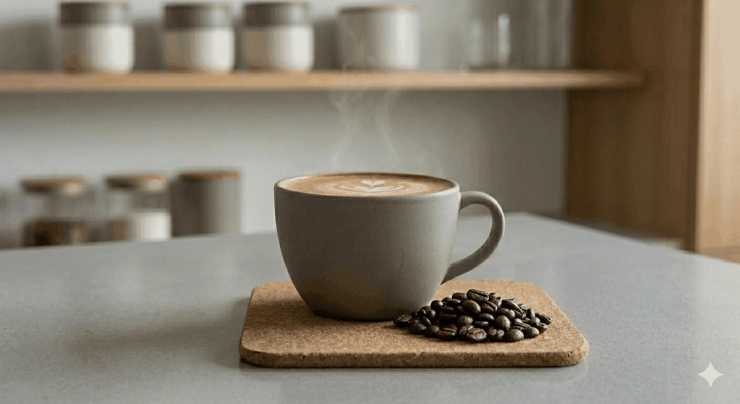
The honest answer: it depends on your budget — and the budget thresholds are very specific. Under $120, a quality manual grinder produces more consistent grounds than any electric at the same price. The burrs in hand grinders at that price tier are simply better-made than what budget electric brands can fit at equivalent cost.
Above $150 on electric, the two approaches converge. Grind consistency from an Encore is genuinely good for filter brewing. Above $200–$250, premium electric grinders — particularly flat burr designs — can edge ahead for espresso precision.
Two other factors worth knowing: low-RPM motors (like the Encore's 450 RPM) reduce heat buildup during grinding, which protects volatile aromatics. And ceramic burrs vs steel burrs: ceramic retains less heat but is more brittle; steel is more durable and the dominant choice in serious grinders at both price points. The SCA brewing standards identify uniform grind size as foundational to balanced extraction, and comparative extraction research confirms that grind consistency directly correlates with cup quality — which is exactly why the burr quality in your grinder matters so much.
Which Brew Methods Suit Each Grinder Type?
Not every brew method needs the same grind precision. Here's a straightforward guide to what works with what.
| Brew Method | Manual / Hand Grinder | Electric Grinder |
|---|---|---|
| Espresso | Possible — needs premium manual | Strongly preferred |
| Pour over / V60 | Excellent | Excellent |
| AeroPress | Excellent | Excellent |
| French press | Excellent | Excellent |
| Cold brew | Good | Good |
| Drip coffee maker | Works well for 1–2 cups | Better for larger batches |
| Travel / camping | Ideal — no power needed | Not practical |
Budget Guide: What to Expect at Each Price Point
| Budget | Best Manual Option | Best Electric Option | Personal Comment |
|---|---|---|---|
| Under $50 | Basic ceramic burr hand grinder (not Timemore). Grinds are decent, adjustment is fiddly. | Blade-only or near-blade quality. Avoid. | Manual wins clearly |
| $50–$120 | Timemore C2 (~$69) — genuinely excellent burr grinder for pour over and filter | Poor burr quality across the board at this range. Don't bother. | Manual wins clearly |
| $120–$200 | 1Zpresso JX-Pro (~$119) — step-up with espresso capability | Baratza Encore (~$179) — the electric quality floor. | Draw — depends on lifestyle |
| $200+ | Premium hand grinders (Comandante C40, etc.) for the obsessive traveller | Fellow Ode, Eureka Mignon — flat burr, proper espresso options. | Electric wins for convenience |
Who Should Choose a Manual Coffee Grinder?
Choose a manual grinder or hand grinder if you are:
- •Budget-first: you want the best grind quality your money can buy, and under $120, a hand grinder wins every time. Start with the Timemore C2.
- •A traveller or camper: hand grinders are the only practical option when you're away from home. Pocket-sized, silent, no power needed.
- •Grinding for one or two cups: capacity limits don't matter when you're making a single pour over before work
- •In a shared home with light sleepers: a hand grinder is whisper-quiet. An electric burr grinder at 6am is not
- •Getting into specialty coffee for the first time: a hand grinder is a low-cost, low-risk way to learn the difference fresh grinding makes before committing to a $200 electric
Who Should Choose an Electric Grinder?
Go electric if you are:
- •Making coffee for two or more people daily: grinding 40–60g by hand every morning will get old fast. The speed advantage of an electric is worth paying for
- •An espresso drinker: dialing in espresso involves frequent small adjustments. Labeled grind settings on an electric make this significantly easier and more repeatable
- •Short on time: 35–45 seconds vs 2 minutes might seem trivial until it's 7am on a Tuesday
- •Finding the hand grinder grind tedious: honest self-assessment matters. If cranking feels like a chore after week one, it'll stay a chore
- •Brewing in larger batches: cold brew, large French presses, batch drip — a hand grinder's 30–40g capacity becomes limiting
Conclusion:
Start with a good manual grinder. I can tell you this: on a budget, nothing beats manual for grind quality. But if you work from home and make coffee every day, go electric. Convenience matters more than people admit. The Baratza Encore (~£150–£180) is the point where electric grinders actually become worth buying because it is solid, consistent, and proven, even if it’s a bit loud. Want espresso without spending big on electric? The 1Zpresso JX-Pro is one of your choices.
Simple rule: start manual for value, go electric when daily use makes convenience non-negotiable.